AI can now predict the future
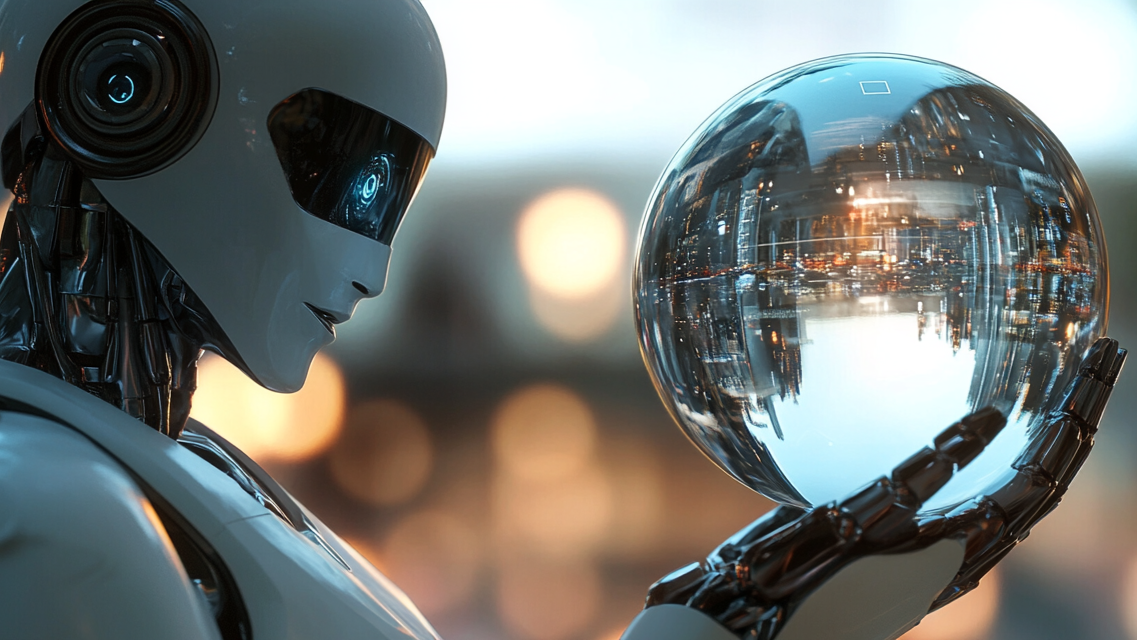
What if I told you AI can now determine exactly which deals in your pipeline will close this quarter?
Or which product SKUs will run out of inventory in 90 days?
The real question isn’t whether AI can predict the future – it’s whether it can do it better than you.
Famously, predicting the future is easy, the hard part is getting it right. That core adage still applies, whether you rely on Nostradamus, tea leaves, or the latest AI software. McKinsey has published several insights on the impact of AI-driven forecasting in supply chain management and suggests that it can reduce errors by 20-50%, translating into huge cost savings.
In this post we will explore different strategies, see where AI can help, and what type of predictions are still out of reach… don’t grab those lottery tickets yet! Let’s start by exploring the categories of future modeling, and where we most frequently use them in business.
Models of the future
Here are the common ways organizations like to think about what may happen next.
Forecasts: e.g., sales forecast, demand forecast, weather forecast. These are all common documents we are familiar with, and that are produced on a daily or weekly basis. They typically use current + historical data to project what will happen.
Trends: are patterns of change observed over time that can signal directionality in behavior, or fashion, culture, technology, and more. They are not predictive, as such, but can inform strategic planning, e.g. an increasing number of people aged 30-40 are renting rather than buying homes, so let’s acquire/build more rental properties.
Scenarios: are models of potential future events. They explore possibilities rather than make predictions but can be useful to help organizations determine the best course of action. They often are based on sets of results, e.g. best case, worst case, reasonable case for cashflow in a business, based on different sales estimates.
Projections: are similar to forecasts but come with explicit assumptions and may be more speculative or long-term. e.g. if fertility rates decline to 1.5 globally, the world population will peak at 10 billion in 2070.
Backcasting: starts with a desired future state and works backwards to see what needs to happen for this to occur. e.g. to achieve net-zero carbon emissions by 2050, we need to do x, y and z.
Foresight: is the ability to anticipate what may happen and to plan accordingly, and in a business context (or government) it combines the earlier approaches in a systematic process to explore possible, probable, and preferable futures in order to make strategic decisions today. It is less about accurate prediction, and more about capable preparation, e.g. ‘The Future of Food in 2050’ might be a report that includes scenarios, trends, some projections, and even a list of potential black-swan events. ‘Thanks to her foresight, the company was able to survive the supply chain disruptions caused by the introduction of tariffs’.
The Turkey at Thanksgiving
There are some well-known challenges in predicting the future, and the turkey is one of the best known. To the turkey, every day leading up to Thanksgiving seems to confirm that life is good. It is well fed, safe, and cared for. From the turkey’s perspective, each day reinforces the expectation that the next will be the same—until, of course, it isn’t. The sudden reversal in the turkey’s fortune is catastrophic and entirely unforeseen from within its frame of reference. Nassim Nicholas Taleb uses this parable to illustrate the risk of what he terms ‘Black Swan events’, which are rare but impactful situations that lie outside of the realm of standard expectations. It’s also a cautionary tale that shows what matters most about the future may not be what stays the same, but what changes abruptly.
Of course, in the turkey example you might argue that if the data had gone back further, the turkey would have been forewarned. However, there are plenty of situations where this is not the case. The list of black swan events that have changed the course of history is long and well known, perhaps starting with a well-known asteroid strike, through to the black death, and on to more modern events such as the dot-com crash, 9/11, or Covid.
Can AI see further than we can?
This is where AI offers an intriguing promise. Unlike the turkey, AI isn’t emotionally invested in the status quo and isn’t limited by the same biases (it has its own!). Modern AI systems can ingest vast quantities of data — far beyond what any analyst or team could reasonably process — and surface patterns, outliers, or weak signals that might go unnoticed. In financial markets, weather systems, and consumer behavior, AI models have already demonstrated their ability to outperform humans in specific, well-bounded forecasting tasks. But does that mean they are the modern equivalent of a soothsayer? No.
What AI systems can do is generate better-informed estimates, at scale, with speed.
It can also rapidly model multiple scenarios, (often many more than a human team would be capable of in a given time period), spot trends, and help with projections.
Where AI shines
AI excels in domains where large amounts of clean, structured data exists, and where future outcomes are at least partially dependent on past patterns. Think demand forecasting for retail, predictive maintenance in manufacturing, or even early warning systems for disease outbreaks. In these spaces, algorithms can crunch historical data, spot correlations, and continuously adapt their predictions as new data flows in. They’re not infallible, but they are tireless and consistently objective — two traits that can dramatically improve decision-making when compared to the traditional, human-centric approach.
Not all predictions are created equal
However, AI’s abilities drop sharply when confronted with deep uncertainty or black swans — situations where historical data is sparse, unreliable, or simply irrelevant. Political upheaval, technological breakthroughs, or shifts in public sentiment often defy past precedent, and no amount of statistical training can fully prepare a model for something it has never seen. AI can help map possibilities, but it can’t assign perfect probabilities to unprecedented change. That’s why the most effective use of AI in foresight isn’t to replace human judgment, but to augment it, offering insights, challenging assumptions, and running simulations that broaden our perspective.
Next week’s lottery numbers
I know what you’re thinking – surely next week’s lottery numbers are just a forecast? Well, AI can certainly analyze past lottery results, find statistical quirks, and even model number distributions, but it can’t predict a chaotic future. Lotteries, by design, are random and not influenced by historical trends. While you can train a neural network to study every winning number since results began, it won’t help you win. Unless… the results are not truly random. If an algorithm that generates the numbers is flawed, there will be a bias. Likewise, if the balls in a machine are not perfectly weighted, some may come out more frequently than others.
This is how the English engineer Joseph Jagger managed to beat the casinos in Monte Carlo in 1873 to win the equivalent of millions in today’s money, by recording multiple outcomes to identify statistical bias in the roulette wheels. The same trick was used by Gonzalo Garcia-Pelayo, to (legally) beat the roulette tables in Monte Carlo and Las Vegas during the 1990’s. The casinos have adopted strategies to avoid this now, such as rotating the wheels more frequently, swapping parts, and so on.
However, AI can still provide some assistance with the lottery. While it can’t predict the results, it can suggest number combinations that are less commonly picked by others, slightly increasing your share of the winnings if lightning does strike, as you won’t have to split the prize. There was also an academic paper recently published by the University of Manchester, that demonstrated you could purchase 27 carefully selected tickets in the UK National Lottery, and guarantee a win, but not a profit. They used some clever math to ensure at least one ticket would match two numbers, which qualifies for a small prize. However, analysis shows that in 99% of cases the winnings from this strategy would not cover the investment.
Even when true randomness appears to exist, statistical quirks or system flaws may allow slight edges – and AI can spot these faster than any human.
How to avoid being a turkey
We have discovered that AI can predict the future — with qualifiers. It is exceptional at spotting patterns, surfacing hidden correlations, and producing forecasts where clean data and stable systems exist. But it struggles with the unpredictable, the emotional, and the deeply human. That doesn’t mean we should dismiss it — in fact, quite the opposite. Used well, AI can sharpen our foresight, stress-test our assumptions, and extend the limits of what we can reasonably prepare for to help us mitigate risk. The key is knowing what data is available, where to trust the model, and when to use different techniques. These are human skills.
"I once predicted the new Terminal 5 at London Heathrow would have terrible issues when it opened, and my baggage might get lost. Therefore, I chose to fly to a conference via Birmingham instead. My prediction was correct, and T5 was such a disaster that all the baggage handlers from Birmingham were sent to London, leaving me stranded in Prague with only the clothes I was wearing. It is not always satisfying to predict the future - sometimes it’s better to be adaptable."
Coming up in Part Two:
In the concluding post, we’ll move beyond theory and explore practical ways businesses can use AI to improve their critical predictions — based on real customer examples. We’ll look at what makes a good AI-augmented forecast, scenario modeling, and where AI still struggles. Just for fun, I asked ChatGPT what the future will look like, so let me finish with this prediction: the future will feel familiar and alien at the same time — and the people who thrive won’t be the ones who predict it perfectly, but those who adapt with speed, humility, and imagination. AI can’t always tell you what is coming next, but it will help you prepare effectively and give you an adaptable platform to succeed.