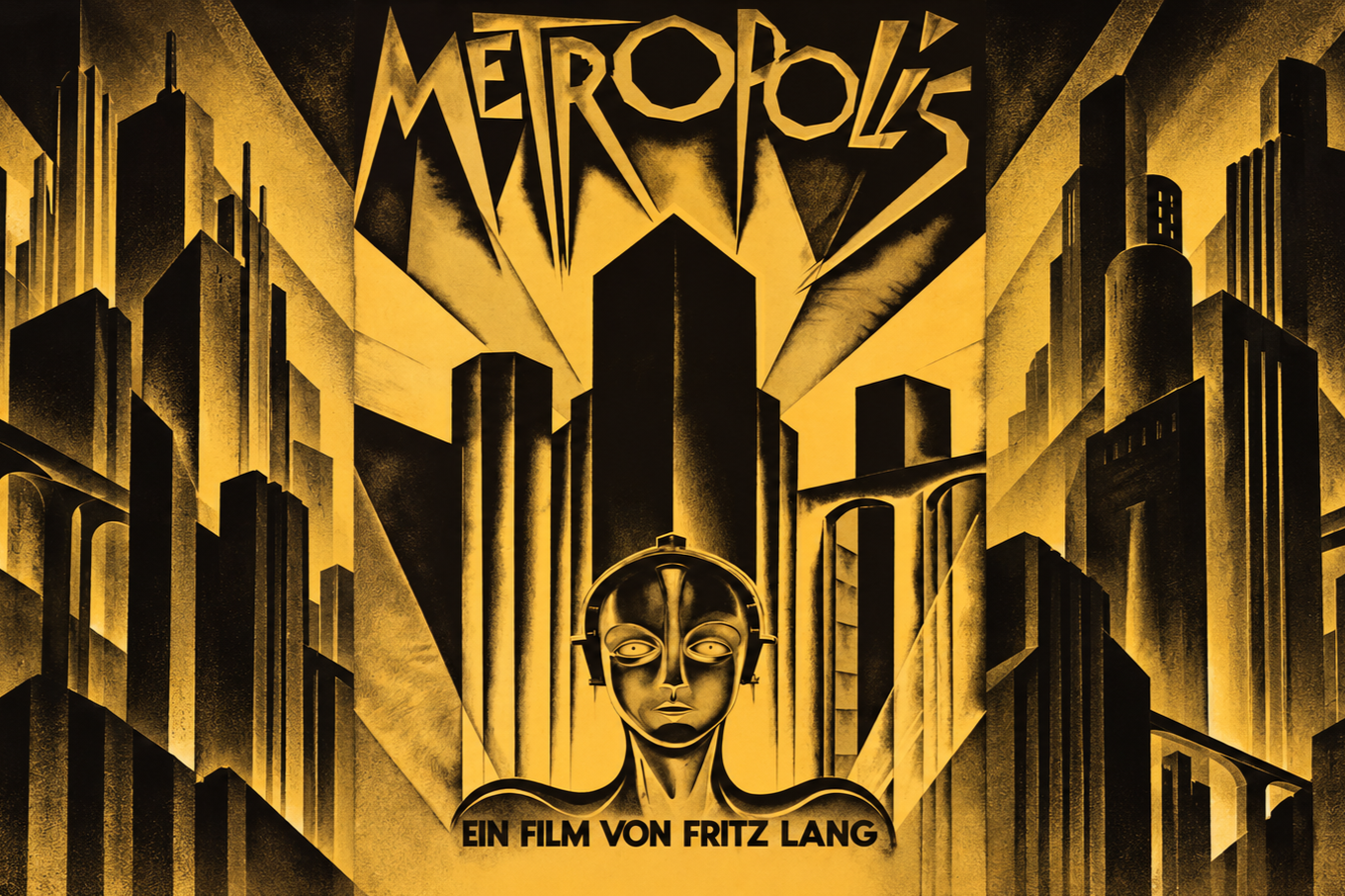
A hundred years ago, the silent movie Metropolis imagined a city in which remarkable technological progress coexisted with extraordinary human inequality.
The people who benefited most were insulated from the people who made it possible — does that sound uncomfortably familiar?
Metropolis was made in 1925/1926, and launched in 1927. A revised version released by Giorgio Moroder in 1984 formally set the story in the year 2026. The original film was one of the most expensive silent movies ever made, and while the critics loved the visual styling, they were not impressed by the narrative, and it was considered a flop. The New York Times called it a ‘…technical marvel with feet of clay.’ These days many rate the movie as one of the top 100 films ever made. As with much sci-fi, it’s tempting to treat the film as a scorecard: which inventions arrived, and which predictions succeeded — even though stories of this type are more often a reflection of topical concerns.
What's in it?
For a modern perspective there are several fascinating aspects: the setting shows the wealthy living in gigantic skyscrapers, while the workers toil in underground factories operating machines (and I can’t help but think this division echoes H.G. Wells The Time Machine, with the Eloi and the Morlocks). There’s a hero who begins the movie as the idle son of the ruler, spending his time engaged in sports and wandering the pleasure gardens. And of course there are two versions of Maria — the human heroine and love interest, along with her duplicate robot, famous from the movie poster. While Maria wasn’t the very first robot to appear on screen, she was certainly one of the earliest and perhaps the most influential. Did you know the Star Wars model of C-3PO was inspired by Maria?
What makes the robot especially interesting is that she is initially constructed by the technology guru (called Rotwang) for a very different purpose. However, the ruler orders Rotwang to make alterations so she will be a perfect copy of Maria. The ruler intends to use the robot to discredit the real human counterpart and deliver fake news to the workers, to keep them under his thumb. You might not be surprised to hear that the ruler and his technology expert secretly have different goals. Rotwang wants to destroy Metropolis, and ultimately his robot Maria sets in motion a riot in which the workers smash the machines and flood the underworld.
The film’s continuing relevance comes from how familiar many of the questions remain:
What is an equitable split of wealth?
Is new technology a good thing?
Who controls it?
Who gets to decide what others believe?
How do we utilize technology for the good of all?
The relationship to our modern world
In Metropolis, inequality has an address. The wealthy live above; the workers labour below. Our arrangements are sometimes harder to see. A service appears on a screen. A delivery appears at the door. The experience is designed to feel effortless, while the hard graft takes place elsewhere. The film offers a useful way of looking at that distance — its underground city is a metaphor for everything a convenient service allows the customers to overlook.
Lang’s workers move their bodies to meet the demands of enormous industrial mechanisms. These days, software often makes the decisions, assigns the targets and monitors performance, following priorities set by the owners. Yet the workers are still moving, to meet the demands of these new software machines.
Then there is the robot Maria. She’s an unsettling ancestor of deepfakes. Her power depends on people believing they recognise the messenger. We’ve all seen or encountered versions of this, and AI is permitting increased sophistication in these attempts. In 2024, an artificially generated imitation of Joe Biden’s voice was used in robocalls discouraging people from voting in New Hampshire’s presidential primary. [FCC account]. The resemblance to Lang’s story lies in the borrowed authority: a familiar identity made to deliver someone else’s message. A convincing artificial person no longer needs a metal body.
Social media
Orwell explored another part of this vision in Nineteen Eighty-Four: power sustained through surveillance and the control of meaning via control of language. Where social media has really changed the old dystopian picture, of both Lang and Orwell, is in how the users themselves produce the materials. Lang could imagine an inflamed crowd. Orwell could depict organised hatred and citizens policing one another. What neither work predicts is the particular arrangement in which millions of people continuously produce, distribute and judge the material through which they are also observed. We supply the photographs, jokes, arguments and accusations. We give them audiences. We help establish what is admirable, shameful or safe to say. Our participation generates both the attraction of the service and information about ourselves. A label can settle a person’s allegiance before their argument is considered. A slogan can make a complicated disagreement feel morally simple.
None of this makes modern life identical to any specific fictional world. Social networks also enable friendship, discovery, public scrutiny and collective action. Their capacity to help people challenge power is part of what makes their influence so consequential.
A message from the past
The film’s politics have always been contested. Its call for reconciliation between rulers and workers struck some critics as naïve and others as authoritarian. It also found admirers among the Nazis, an uncomfortable reminder that an artwork’s message can be interpreted in very different ways. The movie was written in collaboration with Lang’s wife, Thea von Harbou, but in later life they divorced and while Lang moved to the United States to escape the Nazis, von Harbou remained in Germany and wrote state-approved films.
Classic sci-fi remains useful because it reveals vulnerabilities, not because it supplies a timetable. Metropolis ends by proposing that the heart must mediate between the head and the hands. Its answer is human sympathy, expressed through reconciliation between the ruler and the workers.
I think we could all do with a little more sympathy, and empathy. A century later, the unresolved question is how to make that empathy count in the way our machines are designed, owned, and used.