You can’t learn (much) if you can’t remember
I touched a lightbulb with my finger when I was a kid. It hurt — instant blister. I never did that again.
If I couldn’t remember the incident, I might have repeated the mistake, many times. Intelligent life learns and adapts.
Most computer systems don’t learn continuously from experience. They can react, but without an effective memory process, their ability to learn is limited. A system can answer the question in front of it. It can process an input, produce an output, and appear intelligent. But if it can’t retain what happened — what worked, what failed, what was surprising, and how its understanding changed — then every encounter begins from zero. Many of us are seeing context-memory and the benefits when using our personal productivity LLM tools. But this is a limited example. Real learning requires continuity. It requires a past.
Building a knowledge base
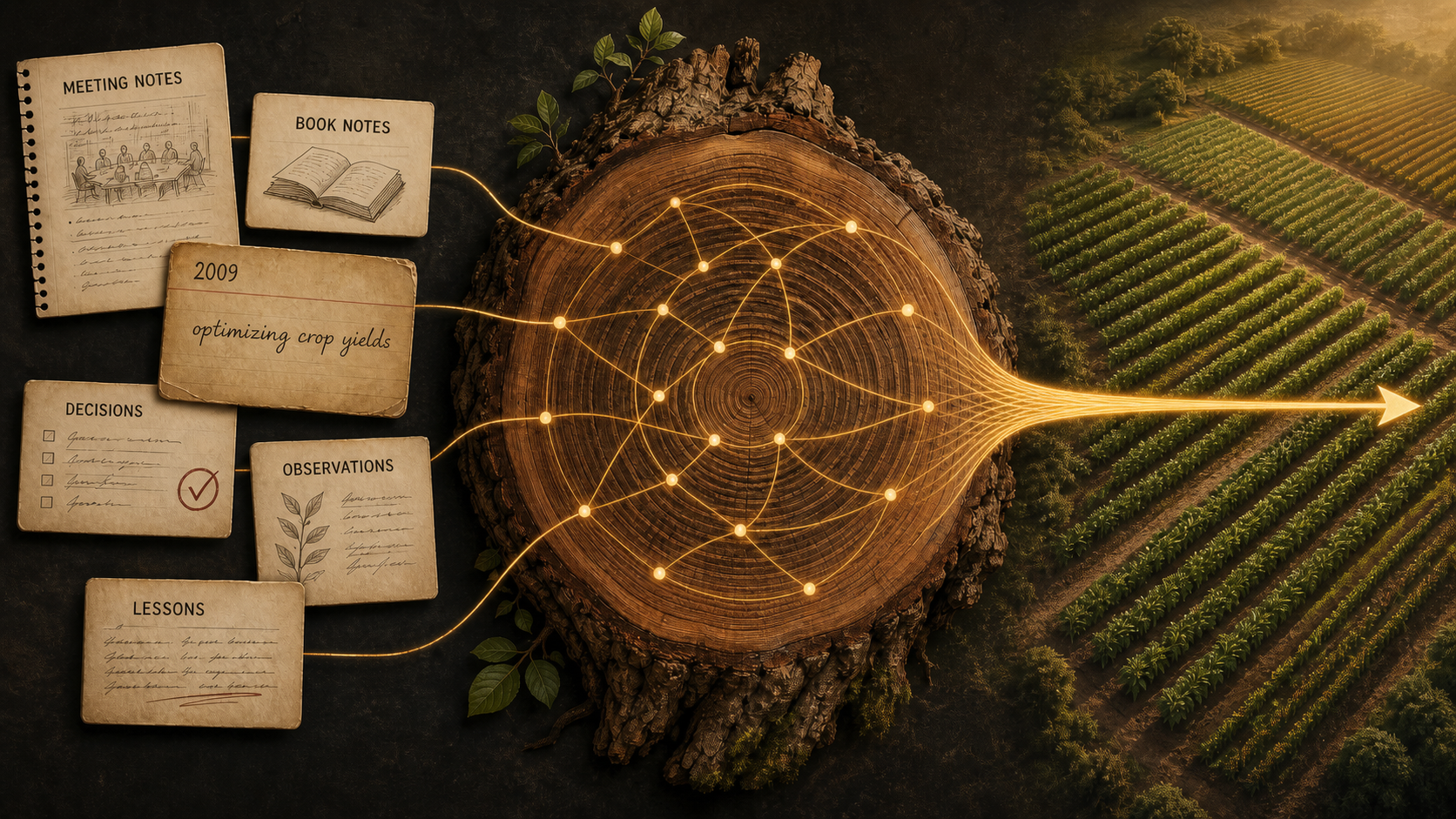
That idea was on my mind as I experimented over the weekend and built a personal knowledge base by collaborating with ChatGPT Work. It’s a place where I can bring together meeting notes, book notes, observations, conversations, decisions, and all the other fragments of thought that accumulate.
The first phase is largely about successful handling of imports. Years of material exist in different formats and locations, each item useful in isolation but far more powerful when connected. A note from a meeting might echo an idea from a book. An observation made in a meeting years ago might illuminate a problem I’m working on today. A forgotten prediction might suddenly look less like speculation and more like the beginning of a design.
The goal was not simply to create a larger archive to store things; knowledge systems help us think. I wanted a system that can recover context, surface relationships, and trace how ideas develop over time. One that remembers not only what I wrote, but when I wrote it, what influenced those ideas, and what happened next. That means memory is not an accessory to the system — it's the foundation that makes learning possible. It’s been a fascinating journey using AI as a coding partner, and I may write about this more in a future post. But first...
A message from the past
For my initial test of the import process, I randomly selected a set of notes on a book. In 2009 one of the (47!) books I read was Hermann Hesse’s The Glass Bead Game. The novel is set in a future intellectual society whose scholars have developed an elaborate game capable of expressing relationships among mathematics, music, philosophy, science, art, and other fields of human knowledge. The game is a kind of universal language for intellectual synthesis: players create meaningful connections across disciplines, revealing an underlying structure shared by seemingly separate ideas. Yet it’s practiced by an elite community largely removed from the practical concerns of the wider world — a tension at the heart of the novel.
I read this book and made my notes several years before SWARM, and had wondered why a system with that much combinatorial power was being devoted to an elaborate cultural game. I made a note at the time that suggested such a powerful tool should be applied to practical problems such as ‘optimizing crop yields’.
Reading that note now felt like receiving a message from an earlier version of myself. At the time, I had no idea where the thought would lead. I certainly didn’t know that I would eventually go on to build the very kind of system I'd imagined. That concept ultimately became SWARM: a system designed to connect knowledge and optimize things that matter in the real world. Its applications have included solving agrifood challenges such as maximizing yield, allocating the right products to the right customers, or planning food production to minimize waste and cost.
With memory, that thread becomes visible as part of a much longer process: an idea noticed, forgotten, rediscovered, and ultimately made real.
A Corporate Learning System
The same principle applies to organizations. Companies generate an extraordinary amount of information every day: meeting notes, project decisions, customer insights, research, experiments, failures, and lessons learned. Most of it ends up scattered across inboxes, documents, chat threads, and the memories of individuals. Even when collected, it's often treated as a warehouse or an archive — a place to store information in case someone needs to look it up later. That’s not enough.
Organizations should be pulling this information together with a more ambitious goal: not to create a corporate archive, but to build a corporate knowledge learning system.
Such a system would:
· preserve the reasoning behind decisions
· connect related insights across teams and time
· surface forgotten lessons when they become relevant
· help the organization recognize patterns in its own experience
It would allow the company not only to remember what it has done, but to continuously improve based on those experiences.
The corporate to-do is therefore clear: start gathering the fragments, but don’t stop at storage. Give the organization a memory process it can actively use. Because a company without memory is condemned to keep rediscovering what it already knows. A company with memory can compound its knowledge — and become a learning organization.
How do you do that? Well, there are some interesting tools evolving, and we have a few tricks up our sleeve at SWARM. I will post more in the coming months. In the meantime, feel free to reach out to discuss, or join in the conversation with a comment below.