68 seconds, 105 times
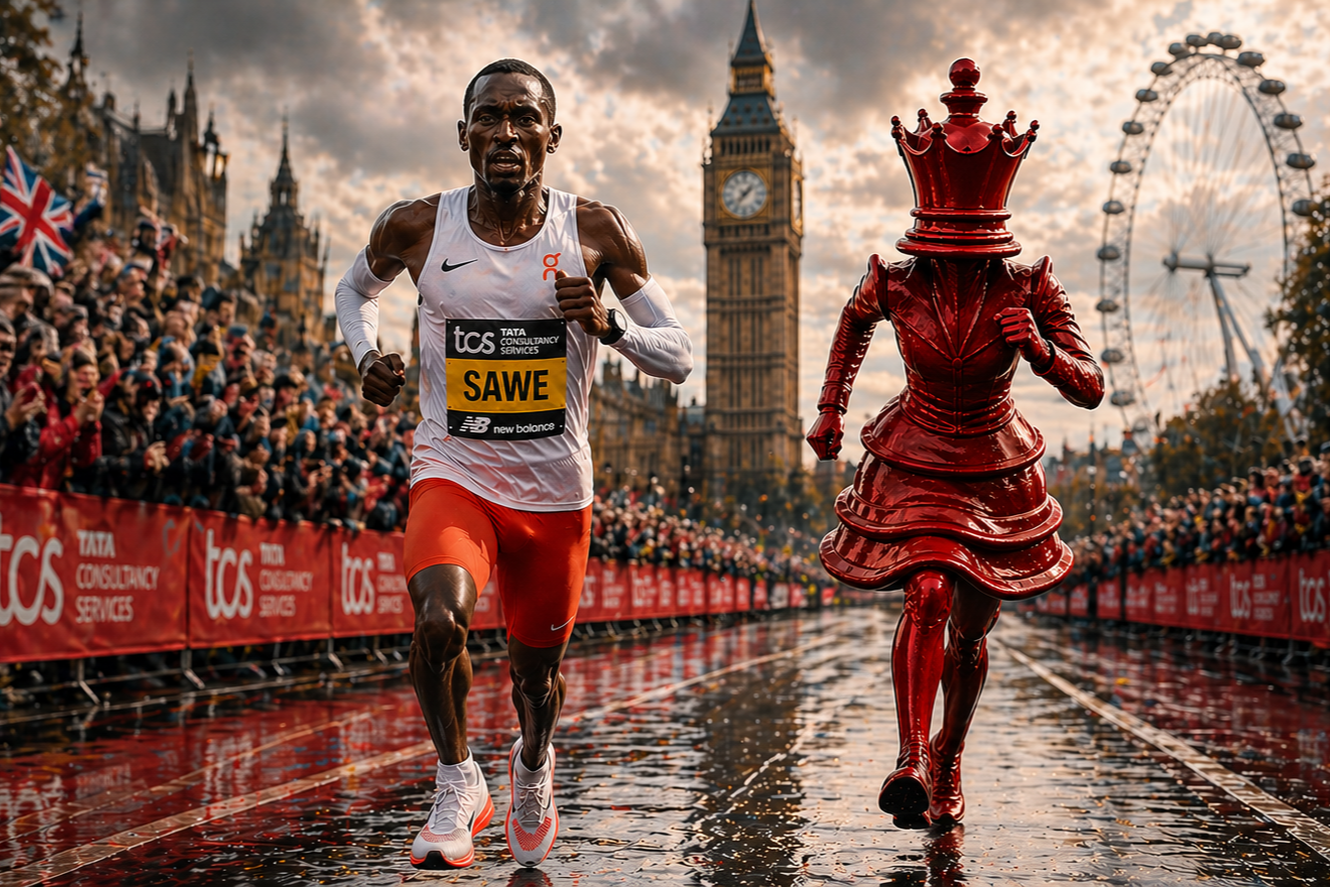
The Pace of Excellence.
Two men have just run the London Marathon in under two hours. For the first time ever, in an official race.
The second-place finisher was running his debut marathon.
Let that sit for a moment. A marathon is 26.2 miles. To run it in the winning time of 1:59:30 requires an average pace of roughly 4 minutes 33 seconds per mile.
That number doesn’t mean much on its own. So let’s translate it into something anyone can relate to. A standard running track lap is 400 meters — just under a quarter mile. At the marathon winning pace, each lap must be completed in about 68 seconds.
Most reasonably fit people, on a good day, might be able to run one lap at that speed. Perhaps. You might want to go out and give it a try. Here’s a little table, that shows how fast most people can run a lap:
Average adult (non-runner):
Likely 90–120 seconds for a single lap at full effort
Recreationally fit adult:
~75–90 seconds for one hard lap
Good club runner:
~65–75 seconds — possibly for a few laps
High school athlete (competitive):
~55–65 seconds — for one lap
Now imagine doing it again.
And again.
And again.
105 times. Without slowing.
That is the new baseline of “winning.”
If you can run one lap at 68 second pace, you are doing well.
If you can run 10, you are exceptional.
If you can run 100, you are redefining what humans can achieve.
The Expanding Edge
What’s striking here isn’t just that the barrier has been broken. It’s how. Not one athlete slipping through a once-in-a-generation gap. But two. Yomif Kejelcha was running this as his debut marathon race.
This is what elite performance looks like today: when the ceiling lifts, it doesn’t drift upward gently. It resets the entire field.
In Alice Through the Looking-Glass, the Red Queen tells Alice:
“It takes all the running you can do, to keep in the same place.”
That line has become a cliché in business. But moments like this give it real weight. Because what we’re seeing isn’t just faster running. It’s a system — training, nutrition, data, shoes, pacing strategy, psychology — all compounding together.
The result: yesterday’s extraordinary performance is today’s entry point.
What This Means for the Rest of Us
Most of us are not elite marathoners. But we are all operating in environments where the bar is moving. In business, you see it in different forms:
· Decision cycles compress
· Customer expectations rise
· Competitors adopt new tools faster
· Margins for error shrink
The uncomfortable truth is that standing still is no longer neutral. It is a form of falling behind.
Three Quiet Implications
Excellence is becoming systemic, not individual: it’s no longer enough to rely on talent or effort alone. The winners are those who assemble better systems — and let those systems compound.
The gap between “good” and “winning” is widening: running a 2:05 marathon used to be world-class. Now it’s not even close. The same is happening in many industries.
New entrants can leapfrog the competition: Tthe second-place runner wasn’t a veteran. He was new to the distance. In business terms: incumbency is less protective than it used to be.
The Real Question
The lesson here isn’t “work harder.” No one runs 4:33 miles for two hours through effort alone (and believe me, I’ve tried!)
A better question is to ask yourself is:
Where is the pace increasing in your world — and what will it take not just to keep up, but to run at that level or faster?
Because the standard is moving. Increasingly, it’s moving faster than feels reasonable.
Most of us haven’t yet realized how fast the race has become.